What this covers:
- Why traditional digital channels are losing ground — and which audience you’re already missing
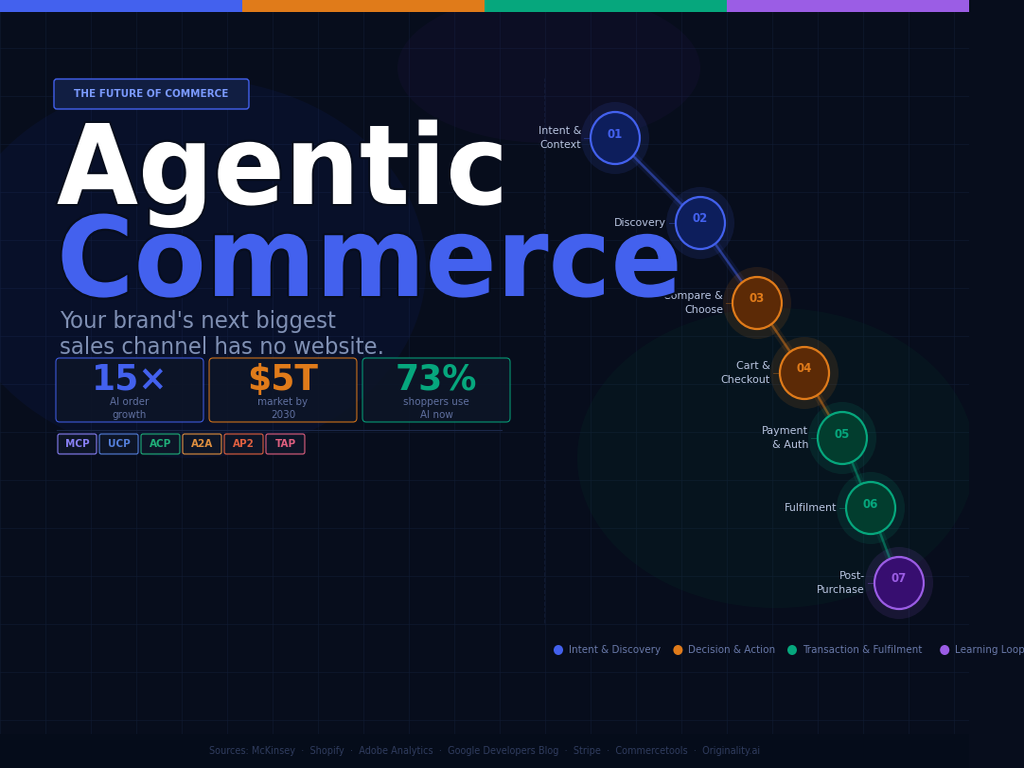
- The 7-step agentic commerce journey, from the moment a user delegates a goal, AI assisted selection, evaluation, and to the moment a purchase is complete
- Few technology considerations for brands deciding to start Agentic Commerce Journey: catalog readiness, protocol adoption, checkout optimization, trust infrastructure
The Quiet Disruption Already Underway
Picture this. Someone wants a height-adjustable standing desk with budget around $499, black finish, arrives by next Friday. In 2022, they opened Google, typed a search query, skimmed four product pages, compared two Amazon listings, and checked out. In 2026, they open ChatGPT or Google AI Mode, describe what they need in plain English, and an agent assists with the rest. No search query. No product page visit. No abandoned cart.No comparison across websites/ apps/ marketplaces.
That is Agentic Commerce. And if your brand isn’t structurally ready for it, you’re already invisible to a growing share of intent rich buyers.
The signals have been building for a while. McKinsey projects Agentic Commerce could mediate $3–5 trillion in global retail by 2030. But the near-term numbers are more immediately alarming. Shopify reported AI-driven orders growing 15× year-over-year in 2025, with AI-referred traffic to its merchant network up 8× in the same period (Shopify, January 2026). Adobe Analytics tracked a 4,700% jump in generative AI traffic to US retail sites between July 2024 and July 2025. Amazon’s Rufus agent alone is generating an estimated $10 billion in annualised sales (Commercetools Radar, 2026).
The infrastructure layer has been moving just as fast. Google launched the Universal Commerce Protocol (UCP) at NRF in January 2026 alongside Shopify, Walmart, Target, and Etsy and with Visa, Mastercard, and Stripe as endorsers (Google Developers Blog, January 2026). OpenAI and Stripe released the Agentic Commerce Protocol (ACP) in September 2025. Mastercard rolled out Agent Pay to all US cardholders by November 2025. These aren’t pilots. These are infrastructure bets by the largest players in commerce and payments.
A lot of brands could miss on the opportunity to entice and engage new and younger customers for life and lose existing customers to this paradigm shift. Seventy-three percent of consumers are already using AI in their shopping journey (Commercetools, 2026). The concentration of that usage skews sharply younger. Gen Z and millennial shoppers aren’t going back to keyword search for product discovery and they’ve moved to conversational AI interfaces the same way they moved from desktop to mobile. If your conversion strategy still assumes shoppers arrive via Google organic or a paid social click, you’re optimising for a funnel that a material share of your highest-LTV future customers will simply never enter.
A 25% decline in traditional search engine volume is already projected for 2026, driven specifically by AI agents and chatbots replacing search queries (Originality.ai, 2026). This time that traffic isn’t disappearing/ dividing into channels, rather it’s rerouting into agent interfaces where entirely different rules govern which products surface and which get purchased. Brands that aren’t legible to those interfaces won’t be discovered. That’s not a risk in far out future. It’s a present one.
The window to establish early advantage is closing. The brands investing in catalog quality, API readiness, and protocol compliance now are building the agentic equivalent of early SEO moats. Early SEO advantage compounded for years because structured, machine-readable data created persistent ranking signals. The same compounding logic applies here, agents that recommend your product once, fulfil reliably, and get positive outcome signals will recommend you again. Brands that wait until 2027 will be optimising their product feeds for AI agents while watching competitors collect the early data, the early customer relationships, and the early learnings (Opascope, April 2026).
The Buyer Journey: 7 Steps of the Agentic Commerce Value Chain
The Agentic Commerce journey looks nothing like the click-path funnel your analytics platform was built to measure. Here is how it actually works and what each step means for your brand.
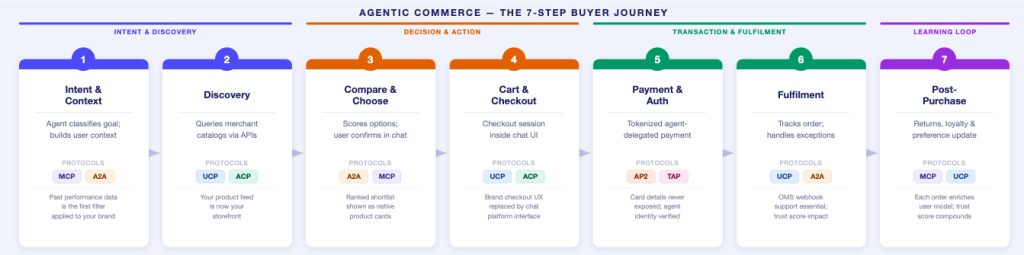
Step 1: Intent classification
The buyer comes with the intent to find right product and quick purchase and not only to search. They usually delegate. “Find me a $499 standing desk, black, arriving Friday.” The intent classification AI agent receives this as a goal. It extracts constraints like budget, colour, deadline and enriches them with personal context that could include past orders, brand preferences, delivery zone, loyalty memberships. All of this happens via MCP (Model Context Protocol) tool calls to preference stores, order history, and calendar data before the agent queries a single merchant.
For brands: Your past performance data is now the first filter applied before your catalog is even consulted. Fulfillment reliability and return history feed this step.
Step 2: Discovery
The discovery AI agent queries merchant catalogs through structured API calls and not web crawls, not HTML pages. Protocols like UCP (Google + Shopify) and ACP (OpenAI + Stripe) define how agents request product data like price, availability, attributes, delivery SLA, return policy. If your catalog endpoint is missing, slow (the target is under 200ms for most of the agentic interfaces), or returning incomplete data, the discovery AI agent moves to the next merchant.
For brands: Your product feed is now your storefront. Completeness and real-time accuracy are the new shelf placement.
Step 3: Comparison, evaluation, and user choice
The comparison AI agent runs multi-criteria scoring across matched products including price delta from budget, delivery match, return policy completeness, review quality, brand trust signals by using reasoning-class LLMs (OpenAI o3, Gemini 2.x, or similar) to resolve trade-offs. What happens next depends on the user’s delegated authority and the product’s complexity.
For straightforward, low-consideration purchases within the user’s pre-approved spend limit, the evaluation AI agent selects and proceeds autonomously. But for higher-consideration decisions or where the agent’s confidence score doesn’t clear a threshold, it surfaces a ranked shortlist directly in the chat interface. This looks like a native product card carousel inside ChatGPT or Google AI Mode providing two or three options with key differentiators called out (price, delivery date, return window), and a one-tap confirm. The user doesn’t leave the conversation. They pick, and the agent proceeds to checkout.
This is a meaningful design moment for brands. The comparison and evaluation AI agents controls what gets surfaced and in what order, but the shortlist presentation ideally containing product name, key attributes, price, is drawn entirely from your structured catalog data. There is no product image carousel powered by your creative team’s best work. There is no editorial copy. The agent renders what your data says, formatted for a chat interface. Incomplete attribute data doesn’t just hurt your ranking but also it limits how meaningfully your product can be presented when it does make the shortlist.
For brands: You are not competing on UX or copy anymore. You are competing on the quality and verifiability of your structured data. A product with a fully defined return policy, GTIN cross-reference, and real-time stock beats a prettier product page and presents more compellingly in a chat-native option card every time.
Step 4: Cart and checkout initiation
Once the user confirms their choice, either via a one-tap option card in the chat interface or autonomously by the AI agent within its mandate, a programmatic checkout session opens. The AI agent sends a structured cart to the merchant’s backend via UCP or ACP ideally through line items, destination address, fulfillment preference, and the buyer’s OAuth linked account token. The merchant responds with a live session object with details like totals, applicable discounts, delivery window, loyalty credit; rendered back into the conversation as a checkout summary card.
What the user sees at this point is still inside the chat. On ChatGPT, it’s an inline browser pane showing the order summary and a confirm button. On Google AI Mode, it’s a native checkout tile powered by UCP with Google Pay pre-filled. On Microsoft Copilot, it’s Copilot Checkout, an embedded flow that doesn’t redirect to the merchant’s site at all. In each case, the merchant’s checkout logic is running behind the scenes via API; the surface the buyer interacts with belongs to the AI platforms.
This matters for brands more than it might first appear. When checkout happens inside the AI platform’s interface, the merchant loses control of the checkout UX including the upsell prompts, the trust badges, the urgency copy, the loyalty tier messaging. That brand equity work simply doesn’t travel into an AI agent mediated checkout session. What does travel is the data like discount eligibility, loyalty balance, delivery options, fulfillment terms, etc. all resolved via UCP’s capability negotiation model based on what the merchant has declared in their UCP profile.
UCP’s graceful handoff mechanism exists for cases where agent-led checkout isn’t sufficient e.g. a furniture retailer requiring a specific delivery time slot, or a brand that mandates account creation before purchase. In those cases, the agent preserves the full session state and transfers the buyer to the merchant’s own checkout UI without data loss. It’s a safety valve, not the default path.
For brands: Headless checkout APIs are not optional infrastructure anymore rather they are the mechanism through which a sale happens without your website. Ensure your discount logic, loyalty resolution, and fulfilment options are all exposed via API, not locked inside a frontend template. What you can’t surface through data, the AI agent cannot show the buyer.
Step 5: Payment and authorization
The agent presents a tokenized payment credential e.g. Mastercard Agentic Token, Stripe Shared Payment Token, or Google Pay via AP2, to the merchant. The buyer’s raw card details are never exposed. Payment networks verify the agent’s identity through protocols like Visa TAP (cryptographic agent signatures) before authorizing. Seventy-eight percent of financial institutions expect fraud to increase with agentic commerce (Accenture via Commercetools, 2026), making verified agent identity the critical bottleneck at this step.
For brands: Accepting tokenized agent payments requires your payment stack to be current. Merchants on Shopify Payments, Stripe, or Adyen are largely covered; legacy PSP integrations may not be.
Step 6: Fulfilment monitoring
After payment, the fulfilment agent tracks the order via UCP’s orders capability leveraging polling for shipping events, exception conditions, and delivery confirmation. If something goes wrong (out-of-stock post-order, shipping delay exceeding the user’s constraint), the fulfilment agent escalates to a fallback, re-ordering from the next-ranked merchant via A2A protocol coordination. The human is notified only if the decision exceeds the agent’s delegated authority.
For brands: Your OMS needs real-time webhook support. Fulfilment exceptions handled poorly don’t just lose this sale but also they reduce your agent trust score for future recommendations that can compound if not resolved or addressed proactively.
Step 7: Post-purchase and preference learning
The completed transaction feeds back into the user’s preference model. Your merchant performance e.g. on-time delivery, return smoothness, product accuracy, etc. becomes an input to the agent’s future recommendations. Returns are handled via UCP’s orders capability without human navigation. Loyalty points are resolved via protocol extensions.
For brands: Every fulfilled order is a compound investment in future discoverability. Every poor experience erodes your agent ranking. Post-purchase is no longer a support function, it is a growth lever.
Few Technology Considerations for Brands to start on the Agentic Commerce Journey
Some of the common question brands should answer is how to lead with discovery optimization (being found by agents) checkout readiness (completing the transaction once found), influencing post purchase outcomes, loyalty redemption, etc. Just note that these are really early trends in Agentic Commerce, a technology that promises commerce revolution in coming months/ years. As the adoption progresses coupled with AI agents capabilities to learn from the live transactions, these attributes/ rules and techniques are likely to be further evolved or transformed beyond cognisance from current state and should be monitored continuously.
Catalog Readiness
Every protocol in the Agentic Commerce stack (UCP, ACP, MCP, AP2, and most likely any upcoming ones) assumes one foundational condition that product catalog is structured, machine-readable, and accurate. Before anything else, structured data, complete attributes, real-time inventory sync, GTIN cross-referencing, and explicit policy fields (return window, warranty, shipping SLA) and similar details should be sorted. This is where most brands have the biggest gap and it affects every layer downstream. Some techniques worth exploring can be to implement JSON-LD Schema.org markup across your top product categories, clean your Google Merchant Center feed to zero disapprovals, and ensure your product attributes go beyond keywords to include machine-decision fields like dimensions, compatibility, sustainability certifiers, and FAQ-style answer fields.
Measure it: Agent Discovery Rate (AI-assisted impressions per 1,000 relevant queries) is the emerging KPI. Early adopters with fully enriched catalogs are seeing 18–22% revenue lifts attributable to UCP transactions (Presta, February 2026).
Protocol and Discovery Compliance
Once your catalog is clean, register for the protocols that match your audience. If your customers are Google Search users then prioritize UCP via Google Merchant Center. If your category skews conversational (fashion, gifting, home) it makes sense to prioritize ACP via Shopify Agentic Storefronts or Stripe’s Agentic Commerce Suite. Both protocols are now live and producing real traffic and the merchants with dual UCP and ACP compliance capture 40% more agentic traffic than single-protocol stores. Start with one, implement the second within few days depending on your target audience and customer acquisition strategy.
AEO (Answer Engine Optimization) is the new SEO for this layer, structured, concise, verifiable information that AI models can ingest, cite, and act on and traditional marketing assets like prose, marketing copy, etc.
Checkout and Payment Optimization
The greatest friction in digital commerce sits in what Commercetools calls “the messy middle” involving checkout, shipping, taxes, and payment authorization (Commercetools, 2026). Most Agentic Commerce sessions that reach checkout still fail there. Brands should expose clean checkout APIs (headless checkout or native UCP/ACP checkout sessions), ensure sub-500ms checkout response times, and verify their PSP supports tokenized agent credentials. Loyalty and discount resolution via UCP extensions directly increases agent driven conversion.
The key consideration here is trust: 87% of CTOs and heads of payments believe trust will be the biggest barrier to agentic payment adoption (Accenture via Commercetools, 2026). Brands that integrate Visa TAP or Mastercard Verifiable Intent signals into their fraud stack will authorize more legitimate agent transactions while blocking the surge in AI-agent fraud attacks.
Post-Purchase and Data Loop
Automate returns via UCP orders capability. Enable loyalty redemption via protocol extensions. Write purchase outcomes back to your preference infrastructure. This layer has the lowest urgency and the highest compounding return considering every well-handled post-purchase interaction improves your agent trust score, increases the probability of repeat recommendations, and builds the preference data asset that will define your competitive position in future.
To conclude, I would like to reiterate that it’s absolutely vital for brands to venture into Agentic Commerce or risk losing a lot of customer base from which it might be very hard or impossible to recover. However, in the short term, the brands may want to hold on to their other digital assets (websites, apps, portals etc.) as they will have subscription, loyalty and other programs running effectively from these. Also, the co-existence of different target audience across these different digital commerce channels is also quite possible. One thing looks guaranteed is that Agentic Commerce is indeed an interesting advancement and promises lot of disruption. One might as well say that this is shaping to be the digital commerce channel that will make/ kill brands in the foreseeable future.
This concludes part 1. Many more to come. Stay Tuned in
Leave a Reply