What this covers:
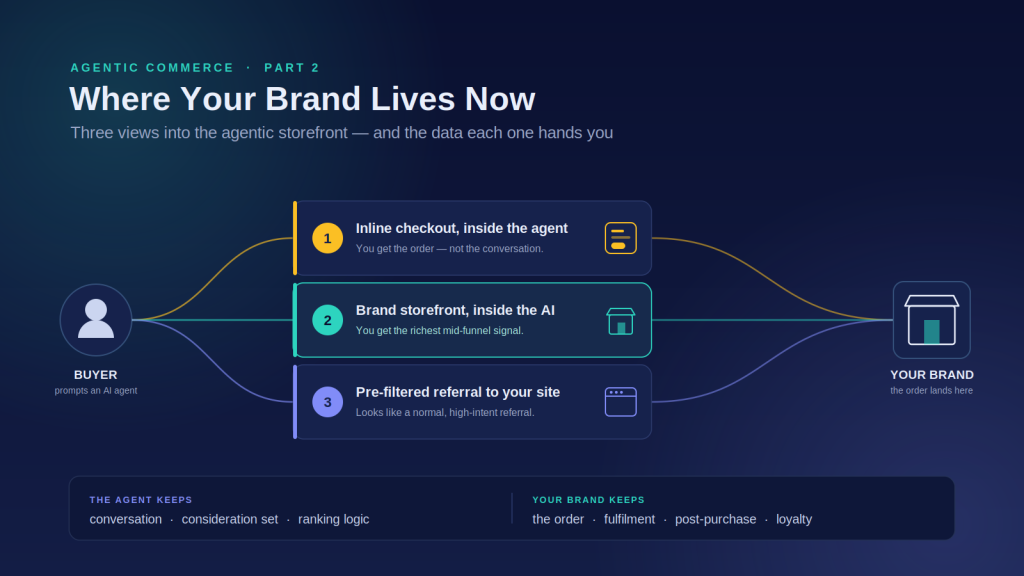
- The buyer now reaches your product three different ways, and each one hands you a different slice of data. Inline checkout inside the agent gives you the order but almost no mid-funnel visibility. A brand-controlled agentic storefront gives you the richest engagement signal and a traditional referral to your site looks normal but hides the upstream query and competitive set. The agent platform always keeps the conversation, the consideration set, and the ranking logic, while you keep the order, fulfilment, and post purchase relationship.
- Winning at this is two separate jobs involving telling agents what you sell, and letting them transact. Telling is a publishing problem solved with one canonical product record fanned out to every protocol dialect (UCP, ACP, and the rest) through feed and product experience tools. Transacting is an exposure problem solved by an agentic storefront platform, integrated for speed or composable for enterprise control, sitting on a protocol on ramp like Stripe’s.
- The durable advantage is in the observability and data foundation, and it has to be built now. No single vendor reconciles a buyer’s journey across all three patterns, so brands need to own the canonical schema and identity layer themselves, instrument every agent facing surface, and treat operational reliability as a ranking signal rather than a cost center. The brands building this layer this year will compound insight competitors structurally cannot catch up on.
For two decades, ecommerce optimization meant to get the buyer to your site, then convert them. The homepage, the PDP, the checkout is all yours, all instrumented, all owned. That model is being unbundled. In agentic commerce, the buyer doesn’t always reach your site. Sometimes they reach a rendering of your product inside someone else’s surface. Sometimes they reach a brand-controlled experience that lives inside an AI chat. And sometimes they reach your website/ mobile app the old-fashioned way, just with the agent having pre-filtered the choice for them. Three patterns are operating in parallel today, and each one changes what you can see about the buyer, and what the Agentic interface (Gemini, ChatGPT, etc.) keeps to itself.
Pattern 1 Inline checkout inside the agent
The buyer asks ChatGPT for running shoes, sees three options as conversational cards, taps Buy, and completes the purchase without ever opening a tab. Google’s UCP-powered Buy button in AI Mode and Gemini works the same way. You, the brand, get the order. You remain the Merchant of Record. You see the order details in your admin with attribution showing ChatGPT or Gemini as the source. What you don’t see: the conversation that led to the purchase, the competing products the agent considered, the user’s broader shopping context, or the reason the agent ranked you first. OpenAI knows. Google knows. You see only the moment of conversion.
Possible Brand Strategy: The optimisation move is to log the full structured query payload of every incoming request, not just the conversions, and track impression share and ranking position as proxies for your platform-side trust score. Walmart’s open-platform strategy (live on both ChatGPT via ACP and Gemini via UCP) is the cleanest example in a sense that by running the same SKU catalog through two agent ecosystems in parallel, Walmart gets cross-platform comparison signal that single-channel brands structurally cannot replicate.
Pattern 2 Agentic storefront with brand-controlled experience
This is the model OpenAI pivoted toward in March 2026 after Instant Checkout underperformed. The buyer explores your brand-controlled storefront inside the AI surface leveraging your photography, your bundles, your loyalty messaging, your size guidance. The transaction either completes there or hands off to your checkout with the cart pre-populated. Shopify’s agentic storefronts and Google’s “transfer items to merchant’s site” option both work this way. You now see meaningfully more session level engagement inside your storefront component, configurator interactions, loyalty signup intent, and post purchase activity. The platform still owns the upstream conversation, but you regain the middle of the funnel.
Possible Brand Strategy: The optimisation move is to treat the storefront as a continuously A/B-tested surface and instrument every interaction inside it including bundle clicks, configurator paths, abandonment patterns, handoff completion rates. Fenty and Steve Madden, both plan on running Shopify-powered agentic storefronts surfaced through Google’s UCP, would be able to capture richer mid-funnel interaction signals than most DTC competitors get from their own websites/ mobile apps today since the storefront is doubling as the instrumentation surface.
Important Upcoming Consideration inside Google Merchant Center (and possibly others soon), is a new AI performance insights tool that gives brands a view of their share of voice on AI surfaces against similar brands, rolling out in Australia, Canada, India, New Zealand, and the US in the coming months. Google is also letting retailers use conversational attributes to rewrite product descriptions to reflect how people search inside AI Mode and Gemini, and is bringing Ask Advisor, a Gemini-powered cross-product agent, into Merchant Center to surface insights across Google Ads and Analytics. That “share of voice on AI surfaces” metric is the closest thing to the trust-score proxy and impression-share instrumentation and it’s a real shipping product, not a speculative capability.
Pattern 3 Traditional referral with agent pre-filtered intent
The buyer reads a recommendation in Perplexity or a non-protocol ChatGPT response, clicks through, and lands on your website/ mobile app. From your analytics, it looks like a normal referral session, except the agent has already done a structured comparison upstream and decided you were worth surfacing. You see everything you’ve always seen i.e., search behaviour, dwell time, add to cart, abandonment. What you don’t see is what query produced the recommendation, who else was in the consideration set, why the agent picked you. The intent quality is high but the upstream context is gone.
Possible Brand Strategy: The optimisation move is to tag agent originated referrals as a distinct session class in your analytics, confirm with behavioural signals like page depth distribution and mouse trace patterns, and run server side capture so the data survives ad-blocker erosion. Brands running first-party attribution stacks like AdBeacon are doing exactly this against the 4,700% year over year growth in generative AI referral traffic Adobe recorded through 2025 and hence, back solving query patterns from conversion data because the front end signal is gone.
The data split, plainly
The agent platform always owns the conversation, the user’s broader context, the consideration set, and the ranking logic. The brand always owns the order, the fulfillment data, the post-purchase relationship, and the loyalty layer. Everything in between including engagement signals, comparison behaviour, configurator usage, abandonment reasoning, is split based on which pattern the transaction follows. Pattern 1 gives you the least mid-funnel visibility. Pattern 2 gives you the most. Pattern 3 gives you what you’ve always had, just with the demand qualified before it arrives.
What to instrument for each pattern
The observability requirements differ meaningfully across the three. For Pattern 1, you need server side capture of every incoming UCP and ACP catalog request with a full parameter payload, not just the conversions plus trust score proxies like impression share by surface, ranking position when shortlisted, and operational SLA adherence per agent platform. Most brands aren’t logging incoming agent traffic at this granularity yet, which means they have zero longitudinal data on which structured queries they’re winning, losing, or never appearing in. For Pattern 2, the instrumentation moves to session level engagement inside the storefront component like configurator interactions, loyalty signup intent, abandonment patterns, handoff completion rates. This is the richest mid funnel data any agentic pattern produces, and the strongest case for prioritising storefront investment. For Pattern 3, you need to separate agent originated referrals from human ones inside your existing analytics, because the behaviour diverges sharply and agents visit roughly 1,000 times as many pages per task as humans do, and treating them as the same session class poisons your conversion benchmarks and personalisation models.
The cross pattern reconciliation problem
The same buyer can interact with your brand across all three patterns in a single week e.g, discovered you in ChatGPT, explored your storefront in Gemini, and ultimately purchased on your website after a referral from Perplexity. No vendor today owns this reconciliation cleanly, and most brands don’t have an internal data model that can connect a Pattern 1 intent signal to a Pattern 3 conversion. The stack forming around the question splits into five layers: agent identification at the edge (HUMAN AgenticTrust, AWS WAF’s AI activity dashboard, Cloudflare, DataDome), protocol gateway and event translation (MetaRouter, Shopify Agentic Storefronts, Stripe ACS), customer data unification (Adobe Real-Time CDP, Salesforce Data Cloud, Databricks as the lakehouse with MCP as connective tissue), attribution analytics (AdBeacon, MetaRouter, Adobe Customer Journey Analytics), and application observability for the catalog APIs themselves (New Relic, Datadog). No single vendor covers all five today, and pretending otherwise is the most expensive mistake a brand can make in this category right now. The pragmatic sequencing for most enterprises:
- Deploy edge agent classification first with advantages being low integration cost, immediate visibility
- Protocol gateway and attribution
- Re-architect the CDP layer onto MCP and A2A
Adobe’s April 2026 CX Enterprise Coworker launch, built on MCP and A2A from day one, signals where the suite vendors are landing. Walmart, Target, Home Depot and Lowe’s are assembling this stack through vendor partnerships rather than internal builds that seems to be the right call given the pace at which the underlying vendor landscape is still reshuffling.
Tell and transact enables the right technology strategy underneath the patterns (at least for near term)
Knowing the patterns is one thing. Acting on them means accepting that agentic commerce is really two jobs, not one, and that conflating them is why most early efforts underwhelm. There is the job of telling the agents what you sell, and the job of letting them transact. These need different architecture, different tools, and different owners.
Telling is a publishing problem. You hold one canonical product record as the single source of truth, and you push it out to every agentic surface in that surface’s own dialect. The hard part is that the dialects keep multiplying. Google wants UCP, OpenAI wants ACP, and ChatGPT, Gemini, Copilot and Perplexity each expect slightly different attributes and signing schemes. If you let each channel team hand maintain its own version of the truth, the messaging drifts, and agents quietly penalise the inconsistency. One record, many machine generated dialects, is the only model that holds up at scale. The tooling here is the feed and product experience category that sat quiet for a decade and is suddenly the busiest front in the standards race: feed syndicators like Feedonomics and Productsup for reach, product experience platforms like Salsify, Akeneo and Syndigo for brand approved content control. One caution worth holding onto. These tools make you readable and present. They do not make you chosen. The selection happens inside the agent, before the buyer sees anything.
Transacting is an exposure problem. Here the buyer browses and checks out, and the platform decision splits along one clean line: integrated versus composable. Integrated platforms, Shopify and BigCommerce, bundle catalog, cart, checkout and payments, and ship agentic features as defaults with little build effort. Composable platforms, commercetools and Salesforce Agentforce Commerce, give enterprises and B2B operations the control that integrated stacks cannot, at the cost of a real engineering investment. The rule of thumb is simple. Above roughly a hundred million in revenue, or with serious B2B complexity, go composable. Below that, integrated is the realistic path. Either way, make depth of UCP and MCP support a hard requirement, because platforms casual about those two protocols are the ones likely to fall away. Underneath both sits the connective layer, where Stripe’s Agentic Commerce Suite is the fastest on ramp into the consumer agent surface, and where you support a small basket of standards rather than betting on a single winner.
The shape that ties it together: a product experience platform as the source of truth, feeding a syndication engine that speaks every dialect, feeding an agentic storefront, sitting on a protocol on ramp, with the observability layer capturing the signal that comes back. Messaging consistency gets enforced where the source of truth meets the feed engine. Intent capture happens where the storefront and APIs meet the agents. The brands that win this are not the ones that pick the cleverest tool. They are the ones that separate telling from transacting, own the canonical record outright, and build the connective layer before their competitors realise the ground has moved.
Conclusion
Brands optimising only for their website/ mobile apps are preparing for the smallest share of future demand. Brands building agentic storefronts retain meaningful experience control and richer data, which is why the early movers like Walmart, Target, Sephora, Nordstrom, Best Buy, Home Depot, Wayfair, are all there. Brands accept pure inline checkout trade visibility for distribution, which is the right call for commodity SKUs and the wrong one for considered purchases. The choice isn’t binary, and it isn’t permanent and most enterprise brands will likely operate all three patterns in parallel for the foreseeable future. The instrumentation discipline, though, has to start now. The buyer is already shopping in surfaces you don’t yet measure, and the brands that build the observability layer this year will spend the near future compounding insight that competitors structurally cannot catch up on.It’s now essential to invest in right technology solutions more than ever since the intent and user important